Freedomain
Politics • Culture • Lifestyle
Crianza Pacífica
What do you think?
August 23, 2024
post photo preview

Stefan Molyneux, Crianza Pacífica


Prólogo

Soy plenamente consciente de que parece melodramático y exagerado escribir una introducción que es básicamente una advertencia de contenido, pero es necesario hacerla.

Este libro es la culminación de cuarenta años de trabajo en los campos de la filosofía, el autoconocimiento, la crianza y la ética.

A través de mi programa “Freedomain”, he tenido el privilegio de mantener profundas conversaciones con miles de personas sobre sus experiencias en la infancia y los efectos que el trauma de estas ha tenido en sus vidas adultas. Me contactan con la esperanza de que mi formación y experiencia en el autoconocimiento y la filosofía moral los ayude a resolver los problemas en sus vidas; espero haberles sido útil.

He entrevistado a muchos expertos en crianza, abuso infantil,  estructuras familiares, terapia y autoconocimiento; estas entrevistas también están disponibles en mi sitio web.

Yo mismo experimenté niveles significativos de abuso infantil. Fui criado por una madre soltera violenta y desequilibrada, la cual terminó siendo internada cuando yo tenía unos trece años.

Hice terapia conversacional tres horas a la semana durante casi dos años.

Al final de mi proceso terapéutico, y después de meses de intentar reparar mi relación con mi familia, decidí separarme de ellos. No he hablado con mi madre en veinticinco años. Mi padre se fue cuando yo era bebé, y tuve poco contacto con él; murió hace unos años.

He estado felizmente casado por más de veinte años y he sido padre, quedándome en casa durante los últimos quince años, cuidando de mi maravillosa hija.

Mi hija estudia en nuestro hogar, y somos parte de una comunidad verdaderamente excepcional de padres con ideas afines.

Mi hija y yo hacemos podcasts juntos, en su mayoría reseñas de películas, que también están disponibles en mi sitio web.

Ahora, la advertencia.

Este es un libro muy intenso.

He intentado escribir este libro dos veces, pero me he visto abrumado por la profundidad y magnitud de la tarea.

Cuando era niño, experimenté una constante, profunda y genuina confusión. Estaba rodeado de personas que afirmaban ser buenas, y que también decían ser expertas en identificar y castigar la inmoralidad. Mis parientes, mis maestros, mis padres, los directores de mi colegio pupilo, todos los sacerdotes que me instruían y mis vecinos: todos afirmaban tener la capacidad de identificar con precisión la inmoralidad y tomar medidas contundentes para contenerla y castigarla.

Fui castigado en la escuela, azotado en el colegio y en la iglesia, por mis padres y parientes; y todo porque afirmaban que me había portado mal y que merecía ser castigado.

Pero lo más extraño era...

Ninguno de los cientos de adultos que me juzgaron y castigaron a lo largo de mi infancia reconoció jamás que mi madre era una abusadora que golpeaba violentamente a sus propios hijos.

Podían detectar señales sutiles de rebeldía o desobediencia en mi comportamiento, castigándome de forma dura o agresiva, pero eran completamente incapaces de identificar las disfunciones mentales y morales evidentes en mi madre, de preguntarme cómo estaba, de tomar alguna acción para protegerme o de oponerse a la violencia a la que estaba sometido.

He estado luchando con esta enorme cuestión durante más de medio siglo.

¿Cómo es posible que los adultos puedan castigar a los niños por transgresiones menores –una vez fui azotado por trepar una cerca para recuperar una pelota de fútbol– pero sean completamente ciegos e impotentes ante adultos abusadores de niños dependientes e inocentes?

Cuando era niño, veía interminables películas y programas de televisión sobre héroes que confrontaban, combatían y vencían a los malos. Los héroes eran buenos, los villanos eran malos, la lucha era clara, las victorias difíciles pero seguras.

Me enseñaron sobre figuras religiosas e históricas que buscaron y lucharon contra malhechores hasta casi la muerte –y a veces más allá, sacrificándose para salvar al mundo de la inmoralidad...

Estos eran los relatos, la historia, la teología. Sin embargo, nadie en mi vida pudo detectar o actuar contra un mal claro en su entorno, incluso dentro de su propia familia, contra su propia sangre...

Expertos rastreadores afirman tener la capacidad de poner su oído sobre una vía de tren y escuchar una locomotora viniendo desde muchos kilómetros de distancia. Si un hombre afirmara tener esta habilidad y fallara en notar un tren gigante que se aproxima a toda velocidad a solo 20 metros de distancia, ¿no sería eso algo bastante extraño?

¿No sería una señal de que, de hecho, este loco?

Imaginen contratar a un guía de safari para llevarlos al corazón de la jungla a fin de tomar fotos de un rarísimo tigre blanco. Imaginen estar en el campamento antes de partir, escuchándolo hablar de todas las complicadas y misteriosas tecnicas que va a usar para rastrear a este tigre blanco, y luego imaginen que su discurso continúa sin pausa mientras un tigre blanco se acerca y se sienta a sus pies.

¡Y su guía no ve nada!

Simplemente sigue divagando, diciendo lo brillante que es para rastrear y detectar tigres increíblemente raros, ¡sin notar en absoluto el enorme animal a sus pies!

Una vez más, ¿no sería un candidato para el manicomio?

¿Confiarías en este loco para guiarte a lo profundo de una jungla sin senderos?

Este es el mundo.
El mundo de los niños.
El mundo de las víctimas de abuso.

Nosotros, las víctimas, vivimos en un mundo que asegura tener una profunda experiencia en la identificación y castigo de los malhechores, mientras recibimos severos castigos por nuestras transgresiones más pequeñas, al mismo tiempo que nuestros abusadores son invisibles, alabados o protegidos y defendidos.

Esto, por supuesto, es la razón por la cual el abuso sigue existiendo.
Los castigos morales solo se imponen a las víctimas indefensas, nunca a los poderosos agresores.

Si, en una cena familiar, una víctima adulta de abuso infantil finalmente revela los horrores que enfrentó, su familia generalmente se sentirá más molesta por las palabras de la víctima que por las agresiones pasadas del abusador.

Esta es simplemente la realidad de dónde y cómo vivimos.
Nuestro mundo está muy lejos del cielo: es un infierno para las víctimas, un paraíso sádico para los abusadores, y una especie de extraño purgatorio para los facilitadores del abuso, que vagan en una neblina de desconexión y evasión, proclamando virtud, pero castigando únicamente a las víctimas que hablan.

Muchas personas han estado esperando este libro con gran anticipación.
Estoy seguro de que los decepcionaré.
Lo siento de verdad, pero este libro tiene que ser como es.
Incontables personas me han rogado durante años que escribiera este libro, y estoy seguro de que las sorprenderé y decepcionaré al mismo tiempo.
También lo siento por eso.

Pero defiendo la necesidad de lo que aquí he hecho.
La gente espera que un libro sobre la crianza pacífica sea... bueno, pacífico, ¿no?
Tiene sentido, lo entiendo...

Pero lograr un mundo pacífico significa exponer y oponerse al mal y a la violencia.
Puedes traer la paz a un pueblo en el salvaje Oeste, pero primero tienes que derrotar a los malos, y eso no es un proceso muy bonito.

Aunque hablo de eso, este libro no trata solo de ser amable con los niños o de razonar con ellos.
Este libro promueve la crianza pacífica eliminando los obstáculos que la impiden.

Este no es un proceso bonito.
No estoy seguro de cuántas personas me escucharán, pero lo diré de todas formas…

Si has golpeado a tus hijos, te ruego que lo consultes con un buen terapeuta antes de leer este libro.
Si has gritado, descuidado o insultado a tus hijos, lo mismo.
Si tienes un trauma significativo no procesado por tu propio abuso infantil, lo mismo.
Si no tienes un corazón bondadoso y de confianza a tu lado, este libro probablemente será extremadamente desestabilizador.

Filósofos y teólogos han escrito sobre el bien y el mal durante miles de años, pero casi nunca sobre la ética y las virtudes de los niños y los padres.
Los socialistas han hablado sobre los males de las disparidades de poder –económicas y políticas– durante cientos de años, pero nunca han abordado la mayor disparidad de poder en el universo humano: la diferencia de poder entre padres e hijos.
Las feministas han hablado sobre los males del patriarcado durante décadas, afirmando que los hombres tienen poderes económicos y políticos mucho mayores que las mujeres, pero nunca han hablado sobre el poder infinitamente mayor que las madres tienen sobre sus hijos, y con qué frecuencia es mal utilizado y abusado.
Los comunistas hablan sobre cómo los dueños de los medios de producción explotan a sus trabajadores pagándoles menos del valor de lo que producen, pero nunca critican la deuda nacional, que es una explotación y esclavitud a los no nacidos –¡seguramente el mayor robo en la historia de la humanidad!

En todo el mundo, se ve esta evasión salvaje: la gente grita sus condenas morales desde los tejados, gritando en las caras de las clases abstractas, las élites políticas, los ricos y bien conectados, pero nunca llegan a las guarderías y jardines de infantes, a las habitaciones oscuras de niños ocultos y maltratados.

Se escuchan interminables diatribas contra el poder del marketing, la propaganda y los males de la publicidad manipuladora, pero ¿con qué frecuencia se reconoce siquiera la programación social infligida a niños indefensos y cautivos en las escuelas públicas?

Este libro enfrentará toda la hipocresía, mentiras y manipulaciones que habilitan y encubren el abuso de niños en nuestra sociedad.

En tu familia.

Porque –ya sabes...
Conoces a algún niño en tu entorno –que tal vez ves todos los días– que es tímido, evasivo y tembloroso, como si estuviera aplastado bajo el peso de una carga invisible.

Y por supuesto, lo está…

La carga no es principalmente el abuso que él o ella está sufriendo, sino tu silencio y evasión.

Nuestra sociedad está configurada de tal manera que es muy difícil saber qué hacer en situaciones de abuso infantil. Si tratamos de proteger al niño, eso podría provocar aún más al abusador, quien todavía mantiene el poder sobre el niño indefenso.
Si confrontamos al abusador, lo mismo.

Solía pensar que todos los adultos a mi alrededor no me protegían porque tenían miedo de provocar aún más a mi madre; soñaba que esperarían hasta que yo fuera independiente, libre de ella, antes de sentarme y contarme sus razones por no haberme ayudado.

Me separé de mi madre cuando tenía quince años.
Trabajé tres empleos, acogí a compañeros de cuarto, pagué mis cuentas, construí mi camino.
Estaba liberado.

A veces miraba el teléfono, mi polvoriento teléfono rojo con dial rotativo, esperando que sonara, esperando que las explicaciones llegaran.
Nada…

Esperé mucho, mucho tiempo.
A mis veintitantos años, mis parientes vinieron de visita a la ciudad para una boda familiar, pasé días con ellos, esperando una palabra, un reconocimiento – una disculpa, tal vez.
De nuevo – nada…

Han pasado treinta años desde entonces – todos están muertos ahora.
Estoy bastante seguro de que ese viejo teléfono nunca sonara.

Pero me han ayudado, de alguna manera – y a través de su ayuda, espero ayudar al mundo.

Cuando era niño, los adultos a mi alrededor no me sermoneaban ni me castigaban porque tuvieran comprensión moral, una capacidad clara para identificar las malas acciones, y una fuerte voluntad para corregir la inmoralidad; había otra razón completamente diferente…
Hablaré de eso más tarde.

Puedes acompañarme, si te atreves.
Pero no será bonito.

Las figuras de autoridad de mi infancia no estaban esperando que fuera adulto para decirme lo mal que se sentían por el abuso que sufrí.
O no se dieron cuenta, o no les importaba.
Es inaceptable.

Una familia solía acogerme regularmente, como un refugiado de la violencia, y se encontraron con mi madre muchas veces.
De nuevo, a mis veintitantos años, me reuní con esta familia otra vez, y la madre me preguntó, con gran simpatía y ternura, “¿Cómo está tu pobre madre?”

Realmente asombroso.

Recuerdo – incluso cuando era niño – que pensé que, si alguna vez alcanzaba alguna clase de prominencia pública, haría todo lo que estuviera a mi alcance para ayudar a las víctimas de abuso infantil.

Aunque personalmente he confrontado a padres agresivos en público, la mayor parte de mi trabajo ha sido por internet, escuchando a miles de víctimas adultas de abuso infantil, empatizando con ellas y proporcionando claridad moral sobre sus desesperadas situaciones.

¿Cuántos de ellos me han dicho alguna vez que los adultos en sus vidas intentaron ayudarlos cuando eran niños? La respuesta ha sido dolorosamente consistente. Cero.

Ningún adulto en sus vidas – pasadas o presentes – ha mostrado la menor pizca de conciencia, comprensión o simpatía por el abuso que sufrieron como niños, ni siquiera los adultos que presenciaron directamente ese abuso.

Durante 18 años, he tenido un canal abierto para cualquiera que quiera hablar sobre cualquier tema filosófico que tengan en mente. He invitado a debates sobre ética, metafísica, epistemología, libre albedrío – lo que sea. Cualquier tema es bienvenido.

Y – ¿de qué quieren hablar las personas, cuando pueden hablar de cualquier cosa?
Casi siempre, de su infancia.

A veces siento que soy la única persona en el mundo que siempre escuchará, empatizará y proporcionará claridad moral a aquellos que han sufrido a manos de malhechores.

Nunca le digo a nadie qué hacer, por supuesto – soy un firme creyente en el libre albedrío, y nunca trataría de que alguien sustituya sus pensamientos por mi juicio.
Les doy un automóvil, pero nunca les digo a dónde conducir.

La moralidad sin control – la moralidad que informa y libera, en lugar de avergonzar y castigar – puede ser profundamente perturbadora.
Si aún no entiendes esto, lo harás en el transcurso de este libro.

Te digo esto: si decides leer este libro, rápidamente te darás cuenta de por qué nunca se ha escrito antes.

Los argumentos no son complicados – la claridad moral es simple.

Este no es un libro que detalla las matemáticas de la física cuántica, las salvajes contradicciones de la teoría de cuerdas, o cómo navegar las leyes fiscales hipercomplejas – o cómo equilibrar los intereses personales, la aceptación social y la integridad moral.
Este es un libro que incluso un niño puede entender.

Este es el libro que tu niño interior ha estado esperando.

Siempre me ha impresionado el hecho de que Sócrates nunca usara lenguaje técnico cuando discutía filosofía con la gente – por ejemplo, no se puede encontrar un solo ejemplo de él usando la palabra “epistemología”.
Aunque ciertamente he escrito obras más técnicas de examen filosófico, me he esforzado por mantener este libro tan claro y accesible como es humanamente posible.

No tiene sentido escribir un manual moral complejo para la mejora del mundo en su conjunto.

Normalmente escribo en párrafos bastante largos – este libro está compuesto principalmente por puntos clave. De hecho, balas.

Si fuiste abusado como niño – y la mayoría de los niños en el mundo lo son, esa es la realidad del mundo – entonces tienes mis más profundas y sentidas condolencias.
Estuvo mal, es inaceptable – ¡y debe cambiar!

Nadie estuvo allí para mí, y eso es una verdadera lástima.

Algunas personas infligen su dolor al mundo – otras proporcionan lo que les fue negado.

Lo siento mucho por tu dolor – fue horriblemente injusto.
Lo siento mucho que – lo más probable – nadie te haya ayudado, o lo haya notado – ni en el pasado ni ahora.
Lo siento mucho que nadie haya estado allí para ti.

Con este libro, puedo estar aquí para ti.
Aquí para ti, ahora.

Es hora.

Comencemos.

community logo
Join the Freedomain Community
To read more articles like this, sign up and join my community today
11
What else you may like…
Videos
Podcasts
Posts
Articles
SHARE PEACEFUL PARENTING!

All donors get the Peaceful Parenting book / audiobook / AI access to share with any and all parents you know who need help!

THANK YOU SO MUCH!

https://www.freedomain.com/donate

00:01:00
The Truth About AI Part 1

Stefan Molyneux looks at the philosophical and moral sides of artificial intelligence, particularly where it crosses with copyright laws and its effects on society. He points out how AI draws from copyrighted materials without getting permission, which brings up issues around intellectual property. Molyneux draws a comparison between standard ways of learning and what AI can do as a customized tutor, noting its ability to deliver information suited to individual needs. He cautions that AI could lower the worth of conventional media and put authors' incomes at risk by turning their creations into commodities. Molyneux calls for an approach where AI firms get approval from the original creators, stressing the importance of acknowledging authors' work as AI becomes more common.

0:00:00 Introduction to AI's Impact
0:00:15 The Ethics of Copyright
0:04:19 Transformative Uses of AI
0:07:55 The Role of AI in Learning
0:16:22 The Nature of AI's Existence
0:20:37 AI and Intellectual Property Issues
0:23:15...

00:24:49
Peaceful Parenting: Immunity to Politics

This clip comes from "Stefan Molyneux on the Scott Adams School!", get the full show at https://fdrpodcasts.com/6302

Raising kids with reason, negotiation, and evidence creates future adults immune to political force. It’s about shaping minds, not just moments. 🌱 Better late than never—plant that seed today!

Watch and share more shorts at https://fdrurl.com/tiktok

00:00:37
How does this X Spaces show sound?

How does this X Spaces show sound?

How does this X Spaces show sound?
A chapter from my new novel...

I'm trying a different style of writing, let me know what you think!

A chapter from my new novel...
Today's X Space...

I had to merge two files, can you tell me if there is any significant overlap?

Thanks!

Today's X Space...
FRIDAY NIGHT LIVE X SPACE WITH STEFAN MOLYNEUX 7pm EST - ONE HOUR TO GO!

Let us talk philosophy, my friends! Bring your questions!

Set a reminder to join the space LIVE:

https://twitter.com/i/spaces/1DGLdvvqOwQGm

Record a question ahead of time at https://fdrurl.com/ama

You can also listen via our streaming platforms:

YouTube: https://fdrurl.com/youtube-live

Locals: https://fdrurl.com/locals-live

Rumble: https://fdrurl.com/rumble-live

Substack: https://fdrurl.com/substack-live

Odysee: https://fdrurl.com/odysee-live

DLive: https://fdrurl.com/dlive

Kick: https://fdrurl.com/kick

Unauthorized TV: https://fdrurl.com/uatv-live

post photo preview
FRIDAY NIGHT LIVE X SPACE WITH STEFAN MOLYNEUX 7pm EST - STARTING NOW!

Let us talk philosophy, my friends! Bring your questions!

Join the space to chat LIVE:

https://twitter.com/i/spaces/1DGLdvvqOwQGm

You can also listen via our streaming platforms:

YouTube: https://fdrurl.com/youtube-live

Locals: https://fdrurl.com/locals-live

Rumble: https://fdrurl.com/rumble-live

Substack: https://fdrurl.com/substack-live

Odysee: https://fdrurl.com/odysee-live

DLive: https://fdrurl.com/dlive

Kick: https://fdrurl.com/kick

Unauthorized TV: https://fdrurl.com/uatv-live

post photo preview
GET MY FREE BOOK ‘PEACEFUL PARENTING’!!

Whether you have children, will have children, or know those who have children, you MUST get your hands on 'Peaceful Parenting'!

'Peaceful Parenting' is the culmination of my life's work in philosophy.

I've spoken with countless parents who have taken these principles and raised their children peacefully, joyously, and morally.

I go over the why, the how, and the evidence for the virtues and power of 'Peaceful Parenting'.

You can easily listen to the audiobook, or read in a variety of formats. If you are pressed for time, there is an abridged version so you can get the essentials. There are even translations of the book into Spanish and Russian, as well as a powerful multilingual AI to ask any questions you need!

Everything is available FOR FREE at https://peacefulparenting.com/

Do not delay! Change your parenting for the better, towards morality, and help build a better world!

'Peaceful Parenting' is how we will get to a truly virtuous and free society.

Go to ...

post photo preview
post photo preview
Freedomain Premium Content!
In the vast tapestry of human experience, this collection of premium content stands as a beacon of reflection and introspection! Each episode is a journey into the complexities of our shared existence. From the intricate dance of self-forgiveness to the harrowing tales of personal adversity, these moments of life challenge, provoke, and inspire.


If you are not already a supporter checkout everything you are missing out on in the Preview Article.


Only for Supporters
To read the rest of this article and access other paid content, you must be a supporter
Read full Article
post photo preview
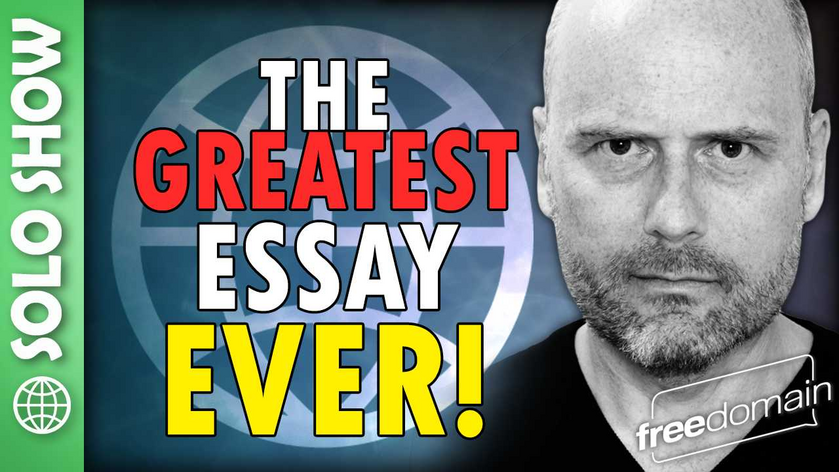
THE GREATEST ESSAY IN THE HISTORY OF PHILOSOPHY

Humanity evolves through accumulated wisdom from endless trial and error. This wisdom has been transmitted through fiction – stories, superstitions, commandments, and ancestor-worship – which has created the considerable problem that these fictions can be easily intercepted and replaced by other lies. 

Children absorb their moral and cultural wisdom from parents, priests and teachers. When governments take over education, foreign thoughts easily transmit themselves to the young, displacing parents and priests. In a fast-changing world, parents represent the past, and are easily displaced by propaganda. 

Government education thus facilitates cultural takeovers – a soft invasion that displaces existing thought-patterns and destroys all prior values. 

The strength of intergenerational cultural transmission of values only exists when authority is exercised by elders. When that authority transfers to the State, children adapt to the new leaders, scorning their parents in the process. 

This is an evolutionary adaptation that resulted from the constant brutal takeovers of human history and prehistory. If your tribe was conquered, you had to adapt to the values of your new masters or risk genetic death through murder or ostracism. 

When a new overlord – who represents the future – inflicts his values on the young, they scorn their parents and cleave to the new ruler in order to survive. 

Government instruction of the young is thus the portal through which alien ideas conquer the young as if a violent overthrow had occurred – which in fact it did, since government education is funded through force. 

This is the weakness of the cultural transmission of values – by using ‘authority’ instead of philosophy – reason and evidence – new authorities can easily displace the accumulated wisdom of thousands of years. 

It is a common observation that a culture’s success breeds its own destruction. Cultures that follow more objective reason tend to prosper – this prosperity breeds resentment and greed in the hearts of less-successful people and cultures, who then swarm into the wealthier lands and use the State to drain them dry of their resources. 

Everything that has been painfully learned and transmitted over a thousand generations can be scattered to the winds in a mere generation or two. 

This happens less in the realms of reason and mathematics, for obvious reasons. Two and two make four throughout all time, in all places, regardless of propaganda. The Pythagorean theorem is as true now as it was thousands of years ago – Aristotle’s three laws of logic remain absolute and incontrovertible to all but the most deranged. 

Science – absent the corrupting influence of government funding – remains true and absolute across time and space. Biological absolutes can only be opposed by those about to commit suicide. 

Authority based on lies hates the clarity and objectivity – and curiosity – of rational philosophy. Bowing to the authority of reason means abandoning the lies that prop up the powerful – but refusing to bow to reason means you end up bowing to foreigners who take over your society via the centralized indoctrination of the young. 

Why is this inevitable? 

Because it is an addiction. 

Political power is the most powerful – and dangerous – addiction. The drug addict only destroys his own life, and harms those close to him. The addiction to political power harms hundreds of millions of people – but the political junkies don’t care, they have dehumanized their fellow citizens – in order to rule over others, you must first view them as mere useful livestock instead of sovereign minds like your own. 

Just as drug addicts would rather destroy lives than stop using – political addicts would rather be slaves in their own sick system than free in a rational, moral world. 

If we cannot find a way to transmit morals without lies or assumptions, we will never break the self-destructive cycle of civilization – success breeds unequal wealth, which breeds resentment and greed, which breeds stealing from the successful through political power, which collapses the society. 

If we cannot anchor morals in reason and evidence, we can never build a successful civilization that does not engineer its own demise. Everything good that mankind builds will forever be dismantled using the same tools that were used to build it. 

Since the fall of religion in the West – inevitable given the wild successes of the free market and modern science and medicinewhich came out of skepticism, reason and the Enlightenment – we have applied critical reasoning to every sphere except morality. We have spun spaceships out of the solar system, plumbed the depths of the atom and cast our minds back to the very nanoseconds after our universe came into being – but we cannot yet clearly state why murder, rape, theft and assault are wrong. 

We can say that they are “wrong” because they feel bad, or are harmful to social cohesion, or because God commands it, or because they are against the law – but that does not help us understand what morality is, or how it is proven. 

Saying that rape is wrong because it feels bad to the victim does not answer why rape is wrong. Clearly it feels ‘good’ to the rapist – otherwise rape would not exist. 

Saying it harms social happiness or cohesion is a category error, since ‘society’ does not exist empirically. Individuals act in their own perceived self-interest. From an evolutionary perspective, ‘rape’ is common. The amoral genes of an ugly man that no woman wants are rewarded for rape, since it gives them at least some chance to survive. 

Saying that rape is wrong because God commands it does not answer the question – it is an appeal to an unreasoning authority that cannot be directly questioned. 

Saying that rape is wrong because it is illegal is begging the question. Many evil things throughout history have been legal, and many good things – such as free speech and absolute private property – are currently criminalized. 

Saying that rape is wrong because it makes the victim unhappy is not a moral argument – it is a strange argument from hedonism, in that the ‘morality’ of an action is measured only by pleasure and painWe often inflict significant misery on people in order to heal or educate them. We punish children – often harshly. The ‘hedonism’ argument is also used to justify sacrificing free speech on the altar of self-proclaimed ‘offense’ and ‘upset.’ 

So… 

Why is rape wrong? 

Why are murder, theft and assault immoral? 

A central tenet of modernity has been the confirmation of personal experience through universal laws that end up utterly blowing our minds. 

The theory of gravity affirms our immediate experience of weight and balance and throwing and catching – and also that we are standing on giant spinning ball rocketing around a star that is itself rocketing around a galaxy. We feel still; we are in fact in blinding motion. The sun and the moon appear to be the same size – they are in fact vastly different. It looks like the stars go round the Earth, but they don’t 

Science confirms our most immediate experiences, while blowing our minds about the universe as a whole. 

If you expand your local observations – “everything I drop falls” – to the universal – “everything in the universe falls” – you radically rewrite your entire world-view. 

If you take the speed of light as constant, your perception of time and space change forever – and you also unlock the power of the atom, for better and for worse. 

If you take the principles of selective breeding and animal husbandry and apply them to life for the last four billion years, you get the theory of evolution, and your world-view is forever changed – for the better, but the transition is dizzying. 

If we take our most common moral instincts – that rape, theft, assault and murder are wrong – and truly universalize them, our world-view also changes forever – better, more accuratemore moral – but also deeply disturbing, disorienting and dizzying. 

But we cannot universalize what we cannot prove – this would just be the attempt to turn personal preferences into universal rules: “I like blue, therefore blue is universally preferable.” 

No, we must first prove morality – only then can we universalize it. 

To prove morality, we must first accept that anything that is impossible cannot also be true. 

It cannot be true that a man can walk north and south at the same time. 

It cannot be true that a ball can fall up and down at the same time. 

It cannot be true that gases both expand and contract when heated. 

It cannot be true that water both boils and freezes at the same temperature. 

It cannot be true that 2 plus 2 equals both 4 and 5. 

If all men are mortal, and Socrates is a man, then it cannot be true that Socrates is immortal. 

If you say that impossible things can be true, then you are saying that you have a standard of truth that includes both truth and the opposite of truth, which is itself impossible. 

The impossible is the opposite of the possible – if you say that both the possible and the impossible can be true, then you are saying that your standard for truth has two opposite standards, which cannot be valid. This would be like saying that the proof of a scientific theory is conformity with reason and evidence, and also the opposite of conformity with reason and evidence, or that profit in a company equals both making money, and losing money. 

All morality is universally preferable behaviourin that it categorizes behaviour that should ideally be chosen or avoided by all people, at all timesWe do not say that rape is evil only on Wednesdays, or 1° north of the equator, or only by tall people. Rape is always and forever wrong – we understand this instinctively, though it is a challenge to prove it rationally. 

Remember, that which is impossible can never be true. 

If we put forward the proposition that “rape is universally preferable behaviour,” can that ever be true? 

If it is impossible, it can never be true. 

If we logically analyse the proposition that “rape is universally preferable behaviour,” we quickly find that it is impossible. 

The statement demands that everyone prefers rape – to rape and be raped at all times, and under all circumstances. 

Aside from the logistical challenges of both raping and being raped at the same time, the entire proposition immediately contradicts itself. Since it is self-contradictory, it is impossible, and if it is impossible, it can neither be true nor valid. 

If “rape is universally preferable behaviour,” then everyone must want to rape and be raped at all times. 

However, rape is by definition violently unwanted sexual behaviour. 

In other words, it is only “rape” because it is decidedly not preferred. 

Since the category “rape” only exists because one person wants it, while the other person – his or her victim – desperately does not want itrape cannot be universally preferable. 

No behaviour that only exists because one person wants it, and the other person does not, can ever be in the category of “universally preferable.” 

Therefore, it is impossible that rape is universally preferable behaviour. 

What about the opposite? Not raping? 

Can “not raping” logically ever be “universally preferable behaviour”? 

In other words, are there innate self-contradictions in the statement “not raping is universally preferable behaviour”? 

No. 

Everyone on the planet can simultaneously “not rape” without logical self-contradiction. Two neighbours can both be gardening at the same time – which is “not raping” – without self-contradiction. All of humanity can operate under the “don’t rape” rule without any logical contradictions whatsoever. 

Therefore, when we say that “rape is wrong,” we mean this in a dual sense – rape is morally wrong, and it is morally wrong because any attempt to make rape “moral” – i.e. universally preferable behaviour – creates immediate self-contradictions, and therefore is impossible, and therefore cannot be correct or valid. 

It is both morally and logically wrong. 

What about assault? 

Well, assault occurs when one person violently attacks another person who does not want the attack to occur. (This does not apply to sports such as boxing or wrestling where aggressive attacks are agreed to beforehand.) 

This follows the same asymmetry as rape. 

Assault can never be universally preferable behaviour, because if it were, everyone must want to assault and be assaulted at all times and under all circumstances. 

However, if you want to be assaulted, then it is not assault. 

Boom. 

What about theft? 

Well, theft is the unwanted transfer of property. 

To say that theft is universally preferable behaviour is to argue that everyone must want to steal and be stolen from at all times, and under all circumstances. 

However, if you want to be stolen from, it is not theft – the category completely disappears when it is universalized. 

If I want you to take my property, you are not stealing from me. 

If I put a couch by the side of the road with a sign saying “TAKE ME,” I cannot call you a thief for taking the couch. 

Theft cannot be universally preferable behaviour because again, it is asymmetrical, in that it is wanted by one party – the thief – but desperately not wanted by the other party – the person stolen from. 

If a category only exists because one person wants it, but the other person doesn’t, it cannot fall under the category of “universally preferable behaviour.” 

The same goes for murder. 

Murder is the unwanted killing of another. 

If someone wants to be killed, this would fall under the category of euthanasia, which is different from murder, which is decidedly unwanted. 

In this way, rape, theft, assault and murder can never be universally preferable behaviours. 

The nonaggression principle and a respect for property rights fully conform to rational morality, in that they can be universalized with perfect consistency. 

There is no contradiction in the proposal that everyone should respect persons and property at all times. To not initiate the use of force, and to not steal, are both perfectly logically consistent. 

Of course, morality exists because people want to do evil – we do not live in heaven, at least not yet. 

Universally preferable behaviour is a method of evaluating moral propositions which entirely accepts that some people want to do evil. 

The reason why it is so essential is because the greatest evils in the world are done not by violent or greedy individuals, but rather by false moral systems such as fascism, communism, socialism and so on. 

In the 20th century alone, governments murdered 250 million of their own citizens – outside of war, just slaughtering them in the streets, in gulags and concentration camps. 

Individual murderers can at worst kill only a few dozen people in their lifetime, and such serial killers are extraordinarily rare. 

Compare this to the toll of war. 

A thief may steal your car, but it takes a government to have you born into millions of dollars of intergenerational debt and unfunded liabilities. 

Now, remember when I told you that when we universalize your individual experience, we end up with great and dizzying truths? 

Get ready. 

What is theft? 

The unwanted transfer of property, usually through the threat of force. 

What is the national debt? 

The unwanted transfer of property, through the threat of force. 

Individuals in governments have run up incomprehensible debts to be paid by the next generations – the ultimate example of “taxation without representation.” 

The concept of “government” is a moral theory, just like “slavery” and “theocracy” and “honour killings.” 

The theory is that some individuals must initiate the use of force, while other individuals are banned from initiating the use of force. 

Those within the “government” are defined by their moral and legal rights to initiate the use of force, while those outside the “government” are defined by moral and legal bans on initiating the use of force. 

This is an entirely contradictory moral theory. 

If initiating the use of force is wrong, then it is wrong for everyone, since morality is universally preferable behaviour. 

If all men are mortal, we cannot say that Socrates is both a man and immortal. 

If initiating force is universally wrong, we cannot say that it is wrong for some people, but right for others. 

“Government” is a moral theory that is entirely self-contradictory – and that which is self-contradictory is impossible – as we accepted earlier – and thus cannot be valid. 

If a biologist creates a category called “mammal” which is defined by being warm-blooded,” is it valid to include cold-blooded creatures in that category? 

Of course not. 

If a physicist proposes a rule that all matter has the property of gravity, can he also say that obsidian has the property of antigravity? 

Of course not. 

If all matter has gravity, and obsidian is composed of matter, then obsidian must have gravity. 

If we say that morality applies to all humanscan we create a separate category of humans for which the opposite of morality applies? 

Of course not. 

I mean, we can do whatever we want, but it’s neither true nor moral. 

If we look at something like counterfeiting, we understand that counterfeiting is the creation of pretend currency based on no underlying value or limitation. 

Counterfeiting is illegal for private citizens, but legal – and indeed encouraged – for those protected by the government. 

Thus, by the moral theory of “government,” that which is evil for one person, is virtuous for another. 

No. 

False. 

That which is self-contradictory cannot stand. 

People who live by ignoring obvious self-contradictions are generally called insane. 

They cannot succeed for long in this life. 

Societies that live by ignoring obvious self-contradictions are also insane, although we generally call them degenerate, decadent, declining and corrupt. 

Such societies cannot succeed for long in this world. 

The only real power – the essence of political power – is to create opposite moral categories for power-mongers. 

What is evil for you is good for them. 

It is disorienting to take our personal morals and truly universalize them. 

So what? 

Do you think we have reached the perfect end of our moral journey as a species? 

Is there nothing left to improve upon when it comes to virtue? 

Every evil person creates opposite standards for themselves – the thief says that he can steal, but others should not, because he doesn’t like to be stolen from! 

Politicians say that they must use violence, but citizens must not. 

Nothing that is self-contradictory can last for long. 

You think we have finished our moral journey? 

Of course not. 

Shake off your stupor, wake up to the corruption all around and within you. 

Like “government,” slavery was a universal morally-justified ethic for almost all of human history. 

Until it wasn’t. 

Read full Article
Essay Feedback Requested!

Good evening, my wonderful donors! I'd appreciate if you could take the time to read this essay and give me your feedback!

Thanks so much!!

Only for Supporters
To read the rest of this article and access other paid content, you must be a supporter
Read full Article
See More
Available on mobile and TV devices
google store google store app store app store
google store google store app tv store app tv store amazon store amazon store roku store roku store
Powered by Locals