

If you are not already a supporter checkout everything you are missing out on in the Preview Article.
Only for Supporters
To read the rest of this article and access other paid content, you must be a supporter


From a reader:
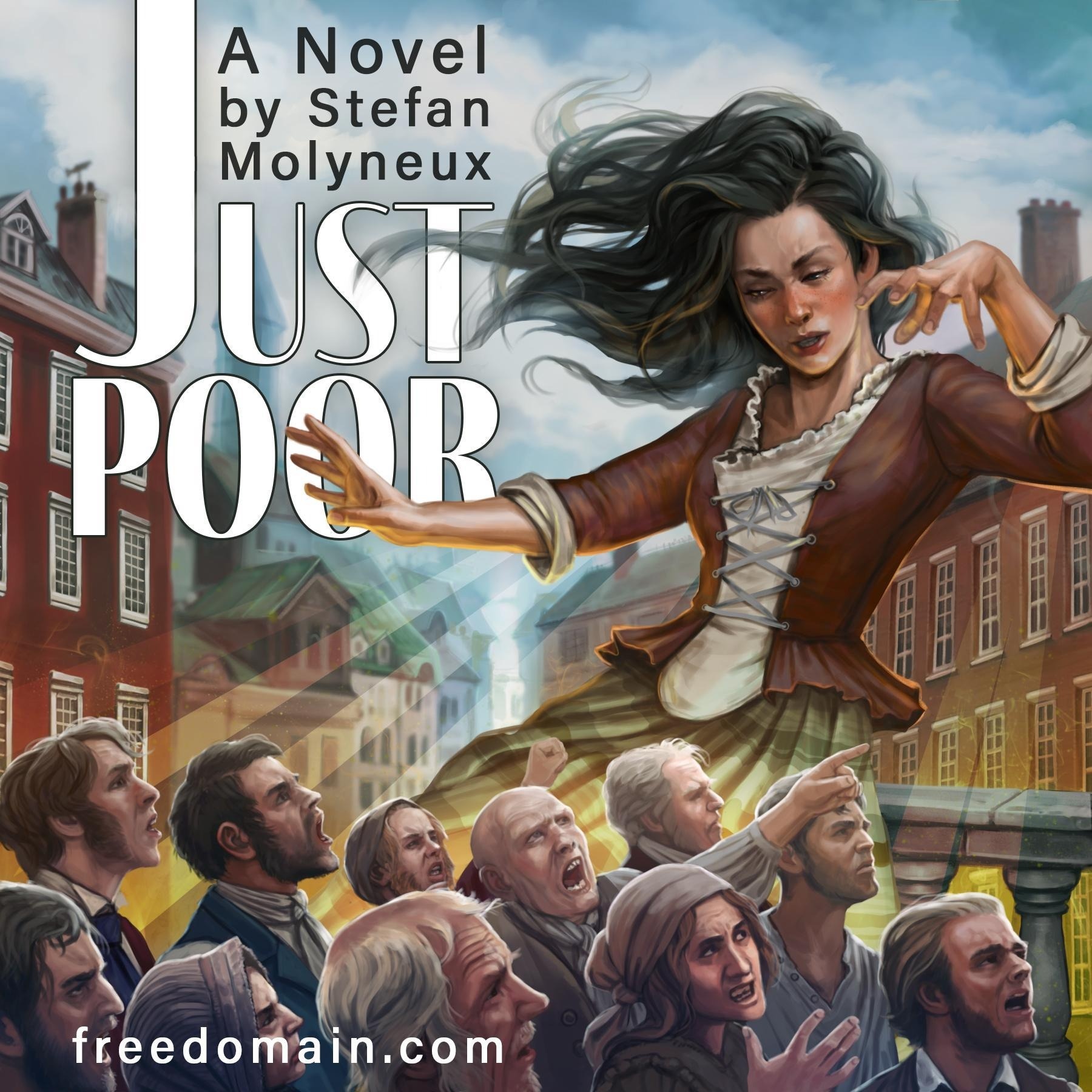
I just finished your book "Just Poor." Man, what an amazing novel. So dense - and the language was so florid that it had to be listened to little by little with full attention. So much suspense and logical events, and well-researched with the winter-beet butterfly effect on agricultural revolution and all, that was lovely. Pretty much a theatre play language. Interesting how English old timers sound more intelligent than the present-day simplified English, eh? Those people were more genuine, vivid and believable than any I know. You have beautifully portrayed the logic of environmental determinism, how the dispossessed equate good and evil with victimhood and privilege, and where it leads, if we accept that definition of good which does not include ourselves. Just Poor was great. I'm considering downloading your novel "Almost" to fill the time between podcasts, once I figure out how to keep it bookmarked.
Read the book here!
All donors get the Peaceful Parenting book / audiobook / AI access to share with any and all parents you know who need help!
THANK YOU SO MUCH!
Philosopher Stefan Molyneux talks with a 23-year-old caller who needs to confront his mother about the abuse and chaos from his father's bullying. Stefan explains how she stayed with a destructive man and why the family keeps tolerating it instead of facing the truth.
Chapters:
0:00:00 Family Wounds and Old Habits
1:05:47 Family Vacation Tension
1:09:43 No-Win Childhood
1:13:44 Smoky Car Dominance
1:15:37 Protecting Your Son
1:20:12 Mom Enables Abuse
1:24:02 Abuse Rewards Work
1:27:58 Off-Ramps Missed Early
1:33:08 Empathy as Parent Duty
1:48:47 Vacation Invitation Manipulation
1:54:15 Manipulation Without Empathy
1:57:23 Parents Never Check In
1:58:53 Why Confrontation Fails
2:03:07 No Future Change
Philosopher Stefan Molyneux explains how to survive AI on X/Twitter livestreams by taking responsibility for your choices and building confidence when you move between different social classes. He also covers why creative work holds up better than routine jobs, why marital promises matter, and how to handle bullying without showing fear.
0:00:00 From Novels to Class Mobility
0:05:55 Growing Up Between Poverty and Privilege
0:17:50 Navigating Wealth, Work, and Bullies
0:25:33 Dating Across Class Divides
0:34:16 Why Climbing Classes Means Leaving People Behind
0:45:15 The Comfort of Staying Stuck
0:53:37 Choices, Consequences, and Secondary Gains
0:59:28 Why Pity Can Keep People Stuck
1:07:04 Creativity in an Age of AI
1:17:11 Faith, Politics, and Feminism
1:21:45 Video Games and Life’s Limited Time
1:26:14 Marriage Vows and Having Children
1:27:33 Making the Case for Parenthood
1:34:48 Teaching Children to Think
Let me know what you think!
https://freedomain.com/my-new-novel-dissolution/
You can also subscribe to the podcast feed! Check it out here: https://rss.com/podcasts/dissolution
The direct feed link is here: https://media.rss.com/dissolution/feed.xml
What is your most important issue in your life? Do you struggle at work, in your relationships, in your marriage, or with your children? Do you have questions about philosophy and morality? The Freedomain Call-in with Stefan Molyneux is waiting for you.
The private call delivers concentrated philosophy directly to your deepest issues... here's what others have had to say:
"I did a private call with Stefan Molyneux. His pointed and profound insight unearthed a core affliction, lifting a Sisyphean weight from my shoulders. Now, each day is imbued with a different hue, offering me a chance at the connections I truly wish to attain."
"Within less than 2h with Stefan, we were able to really go deep and methodically get to the root of my situation. The private setting is invaluable, as you can be fully open and not feel pressured by time or by other people's perception. Highly recommended and much appreciated. This is truly one of the greatest conversations."
...


If you are not already a supporter checkout everything you are missing out on in the Preview Article.
Humanity evolves through accumulated wisdom from endless trial and error. This wisdom has been transmitted through fiction – stories, superstitions, commandments, and ancestor-worship – which has created the considerable problem that these fictions can be easily intercepted and replaced by other lies.
Children absorb their moral and cultural wisdom from parents, priests and teachers. When governments take over education, foreign thoughts easily transmit themselves to the young, displacing parents and priests. In a fast-changing world, parents represent the past, and are easily displaced by propaganda.
Government education thus facilitates cultural takeovers – a soft invasion that displaces existing thought-patterns and destroys all prior values.
The strength of intergenerational cultural transmission of values only exists when authority is exercised by elders. When that authority transfers to the State, children adapt to the new leaders, scorning their parents in the process.
This is an evolutionary adaptation that resulted from the constant brutal takeovers of human history and prehistory. If your tribe was conquered, you had to adapt to the values of your new masters or risk genetic death through murder or ostracism.
When a new overlord – who represents the future – inflicts his values on the young, they scorn their parents and cleave to the new ruler in order to survive.
Government instruction of the young is thus the portal through which alien ideas conquer the young as if a violent overthrow had occurred – which in fact it did, since government education is funded through force.
This is the weakness of the cultural transmission of values – by using ‘authority’ instead of philosophy – reason and evidence – new authorities can easily displace the accumulated wisdom of thousands of years.
It is a common observation that a culture’s success breeds its own destruction. Cultures that follow more objective reason tend to prosper – this prosperity breeds resentment and greed in the hearts of less-successful people and cultures, who then swarm into the wealthier lands and use the State to drain them dry of their resources.
Everything that has been painfully learned and transmitted over a thousand generations can be scattered to the winds in a mere generation or two.
This happens less in the realms of reason and mathematics, for obvious reasons. Two and two make four throughout all time, in all places, regardless of propaganda. The Pythagorean theorem is as true now as it was thousands of years ago – Aristotle’s three laws of logic remain absolute and incontrovertible to all but the most deranged.
Science – absent the corrupting influence of government funding – remains true and absolute across time and space. Biological absolutes can only be opposed by those about to commit suicide.
Authority based on lies hates the clarity and objectivity – and curiosity – of rational philosophy. Bowing to the authority of reason means abandoning the lies that prop up the powerful – but refusing to bow to reason means you end up bowing to foreigners who take over your society via the centralized indoctrination of the young.
Why is this inevitable?
Because it is an addiction.
Political power is the most powerful – and dangerous – addiction. The drug addict only destroys his own life, and harms those close to him. The addiction to political power harms hundreds of millions of people – but the political junkies don’t care, they have dehumanized their fellow citizens – in order to rule over others, you must first view them as mere useful livestock instead of sovereign minds like your own.
Just as drug addicts would rather destroy lives than stop using – political addicts would rather be slaves in their own sick system than free in a rational, moral world.
If we cannot find a way to transmit morals without lies or assumptions, we will never break the self-destructive cycle of civilization – success breeds unequal wealth, which breeds resentment and greed, which breeds stealing from the successful through political power, which collapses the society.
If we cannot anchor morals in reason and evidence, we can never build a successful civilization that does not engineer its own demise. Everything good that mankind builds will forever be dismantled using the same tools that were used to build it.
Since the fall of religion in the West – inevitable given the wild successes of the free market and modern science and medicine, which came out of skepticism, reason and the Enlightenment – we have applied critical reasoning to every sphere except morality. We have spun spaceships out of the solar system, plumbed the depths of the atom and cast our minds back to the very nanoseconds after our universe came into being – but we cannot yet clearly state why murder, rape, theft and assault are wrong.
We can say that they are “wrong” because they feel bad, or are harmful to social cohesion, or because God commands it, or because they are against the law – but that does not help us understand what morality is, or how it is proven.
Saying that rape is wrong because it feels bad to the victim does not answer why rape is wrong. Clearly it feels ‘good’ to the rapist – otherwise rape would not exist.
Saying it harms social happiness or cohesion is a category error, since ‘society’ does not exist empirically. Individuals act in their own perceived self-interest. From an evolutionary perspective, ‘rape’ is common. The amoral genes of an ugly man that no woman wants are rewarded for rape, since it gives them at least some chance to survive.
Saying that rape is wrong because God commands it does not answer the question – it is an appeal to an unreasoning authority that cannot be directly questioned.
Saying that rape is wrong because it is illegal is begging the question. Many evil things throughout history have been legal, and many good things – such as free speech and absolute private property – are currently criminalized.
Saying that rape is wrong because it makes the victim unhappy is not a moral argument – it is a strange argument from hedonism, in that the ‘morality’ of an action is measured only by pleasure and pain. We often inflict significant misery on people in order to heal or educate them. We punish children – often harshly. The ‘hedonism’ argument is also used to justify sacrificing free speech on the altar of self-proclaimed ‘offense’ and ‘upset.’
So…
Why is rape wrong?
Why are murder, theft and assault immoral?
A central tenet of modernity has been the confirmation of personal experience through universal laws that end up utterly blowing our minds.
The theory of gravity affirms our immediate experience of weight and balance and throwing and catching – and also that we are standing on a giant spinning ball rocketing around a star that is itself rocketing around a galaxy. We feel still; we are in fact in blinding motion. The sun and the moon appear to be the same size – they are in fact vastly different. It looks like the stars go round the Earth, but they don’t…
Science confirms our most immediate experiences, while blowing our minds about the universe as a whole.
If you expand your local observations – “everything I drop falls” – to the universal – “everything in the universe falls” – you radically rewrite your entire world-view.
If you take the speed of light as constant, your perception of time and space change forever – and you also unlock the power of the atom, for better and for worse.
If you take the principles of selective breeding and animal husbandry and apply them to life for the last four billion years, you get the theory of evolution, and your world-view is forever changed – for the better, but the transition is dizzying.
If we take our most common moral instincts – that rape, theft, assault and murder are wrong – and truly universalize them, our world-view also changes forever – better, more accurate, more moral – but also deeply disturbing, disorienting and dizzying.
But we cannot universalize what we cannot prove – this would just be the attempt to turn personal preferences into universal rules: “I like blue, therefore blue is universally preferable.”
No, we must first prove morality – only then can we universalize it.
To prove morality, we must first accept that anything that is impossible cannot also be true.
It cannot be true that a man can walk north and south at the same time.
It cannot be true that a ball can fall up and down at the same time.
It cannot be true that gases both expand and contract when heated.
It cannot be true that water both boils and freezes at the same temperature.
It cannot be true that 2 plus 2 equals both 4 and 5.
If all men are mortal, and Socrates is a man, then it cannot be true that Socrates is immortal.
If you say that impossible things can be true, then you are saying that you have a standard of truth that includes both truth and the opposite of truth, which is itself impossible.
The impossible is the opposite of the possible – if you say that both the possible and the impossible can be true, then you are saying that your standard for truth has two opposite standards, which cannot be valid. This would be like saying that the proof of a scientific theory is conformity with reason and evidence, and also the opposite of conformity with reason and evidence, or that profit in a company equals both making money, and losing money.
All morality is universally preferable behaviour, in that it categorizes behaviour that should ideally be chosen or avoided by all people, at all times. We do not say that rape is evil only on Wednesdays, or 1° north of the equator, or only by tall people. Rape is always and forever wrong – we understand this instinctively, though it is a challenge to prove it rationally.
Remember, that which is impossible can never be true.
If we put forward the proposition that “rape is universally preferable behaviour,” can that ever be true?
If it is impossible, it can never be true.
If we logically analyse the proposition that “rape is universally preferable behaviour,” we quickly find that it is impossible.
The statement demands that everyone prefers rape – to rape and be raped at all times, and under all circumstances.
Aside from the logistical challenges of both raping and being raped at the same time, the entire proposition immediately contradicts itself. Since it is self-contradictory, it is impossible, and if it is impossible, it can neither be true nor valid.
If “rape is universally preferable behaviour,” then everyone must want to rape and be raped at all times.
However, rape is by definition violently unwanted sexual behaviour.
In other words, it is only “rape” because it is decidedly not preferred.
Since the category “rape” only exists because one person wants it, while the other person – his or her victim – desperately does not want it, rape cannot be universally preferable.
No behaviour that only exists because one person wants it, and the other person does not, can ever be in the category of “universally preferable.”
Therefore, it is impossible that rape is universally preferable behaviour.
What about the opposite? Not raping?
Can “not raping” logically ever be “universally preferable behaviour”?
In other words, are there innate self-contradictions in the statement “not raping is universally preferable behaviour”?
No.
Everyone on the planet can simultaneously “not rape” without logical self-contradiction. Two neighbours can both be gardening at the same time – which is “not raping” – without self-contradiction. All of humanity can operate under the “don’t rape” rule without any logical contradictions whatsoever.
Therefore, when we say that “rape is wrong,” we mean this in a dual sense – rape is morally wrong, and it is morally wrong because any attempt to make rape “moral” – i.e. universally preferable behaviour – creates immediate self-contradictions, and therefore is impossible, and therefore cannot be correct or valid.
It is both morally and logically wrong.
What about assault?
Well, assault occurs when one person violently attacks another person who does not want the attack to occur. (This does not apply to sports such as boxing or wrestling where aggressive attacks are agreed to beforehand.)
This follows the same asymmetry as rape.
Assault can never be universally preferable behaviour, because if it were, everyone must want to assault and be assaulted at all times and under all circumstances.
However, if you want to be assaulted, then it is not assault.
Boom.
What about theft?
Well, theft is the unwanted transfer of property.
To say that theft is universally preferable behaviour is to argue that everyone must want to steal and be stolen from at all times, and under all circumstances.
However, if you want to be stolen from, it is not theft – the category completely disappears when it is universalized.
If I want you to take my property, you are not stealing from me.
If I put a couch by the side of the road with a sign saying “TAKE ME,” I cannot call you a thief for taking the couch.
Theft cannot be universally preferable behaviour because again, it is asymmetrical, in that it is wanted by one party – the thief – but desperately not wanted by the other party – the person stolen from.
If a category only exists because one person wants it, but the other person doesn’t, it cannot fall under the category of “universally preferable behaviour.”
The same goes for murder.
Murder is the unwanted killing of another.
If someone wants to be killed, this would fall under the category of euthanasia, which is different from murder, which is decidedly unwanted.
In this way, rape, theft, assault and murder can never be universally preferable behaviours.
The nonaggression principle and a respect for property rights fully conform to rational morality, in that they can be universalized with perfect consistency.
There is no contradiction in the proposal that everyone should respect persons and property at all times. To not initiate the use of force, and to not steal, are both perfectly logically consistent.
Of course, morality exists because people want to do evil – we do not live in heaven, at least not yet.
“Universally preferable behaviour” is a method of evaluating moral propositions which entirely accepts that some people want to do evil.
The reason why it is so essential is because the greatest evils in the world are done not by violent or greedy individuals, but rather by false moral systems such as fascism, communism, socialism and so on.
In the 20th century alone, governments murdered 250 million of their own citizens – outside of war, just slaughtering them in the streets, in gulags and concentration camps.
Individual murderers can at worst kill only a few dozen people in their lifetime, and such serial killers are extraordinarily rare.
Compare this to the toll of war.
A thief may steal your car, but it takes a government to have you born into millions of dollars of intergenerational debt and unfunded liabilities.
Now, remember when I told you that when we universalize your individual experience, we end up with great and dizzying truths?
Get ready.
What is theft?
The unwanted transfer of property, usually through the threat of force.
What is the national debt?
The unwanted transfer of property, through the threat of force.
Individuals in governments have run up incomprehensible debts to be paid by the next generations – the ultimate example of “taxation without representation.”
The concept of “government” is a moral theory, just like “slavery” and “theocracy” and “honour killings.”
The theory is that some individuals must initiate the use of force, while other individuals are banned from initiating the use of force.
Those within the “government” are defined by their moral and legal rights to initiate the use of force, while those outside the “government” are defined by moral and legal bans on initiating the use of force.
This is an entirely contradictory moral theory.
If initiating the use of force is wrong, then it is wrong for everyone, since morality is universally preferable behaviour.
If all men are mortal, we cannot say that Socrates is both a man and immortal.
If initiating force is universally wrong, we cannot say that it is wrong for some people, but right for others.
“Government” is a moral theory that is entirely self-contradictory – and that which is self-contradictory is impossible – as we accepted earlier – and thus cannot be valid.
If a biologist creates a category called “mammal” which is defined by being “warm-blooded,” is it valid to include cold-blooded creatures in that category?
Of course not.
If a physicist proposes a rule that all matter has the property of gravity, can he also say that obsidian has the property of antigravity?
Of course not.
If all matter has gravity, and obsidian is composed of matter, then obsidian must have gravity.
If we say that morality applies to all humans, can we create a separate category of humans for which the opposite of morality applies?
Of course not.
I mean, we can do whatever we want, but it’s neither true nor moral.
If we look at something like counterfeiting, we understand that counterfeiting is the creation of pretend currency based on no underlying value or limitation.
Counterfeiting is illegal for private citizens, but legal – and indeed encouraged – for those protected by the government.
Thus, by the moral theory of “government,” that which is evil for one person, is virtuous for another.
No.
False.
That which is self-contradictory cannot stand.
People who live by ignoring obvious self-contradictions are generally called insane.
They cannot succeed for long in this life.
Societies that live by ignoring obvious self-contradictions are also insane, although we generally call them degenerate, decadent, declining and corrupt.
Such societies cannot succeed for long in this world.
The only real power – the essence of political power – is to create opposite moral categories for power-mongers.
What is evil for you is good for them.
It is disorienting to take our personal morals and truly universalize them.
So what?
Do you think we have reached the perfect end of our moral journey as a species?
Is there nothing left to improve upon when it comes to virtue?
Every evil person creates opposite standards for themselves – the thief says that he can steal, but others should not, because he doesn’t like to be stolen from!
Politicians say that they must use violence, but citizens must not.
Nothing that is self-contradictory can last for long.
You think we have finished our moral journey?
Of course not.
Shake off your stupor, wake up to the corruption all around and within you.
Like “government,” slavery was a universal morally-justified ethic for almost all of human history.
Until it wasn’t.