Freedomain
Politics • Culture • Lifestyle
Even more teenage Stef poems... :)
October 26, 2022

Song from the Office of Ice


Playing with staplers

I wonder why

The violence had such a different quality;

It was not skinned knees

Or schoolyard brawls.

It was an infection

There is no other word.


I was curiously invaded

It was not just fists on face

Every movement was noted

Each word, each tic

Stored, responded, corrected, ignored

Consciously.


Born in battle

I am an army out of step

Some have won

Some are being drafted

Some play with toy guns

Some cry for an end to war.


My soul is tight, taut

Focused, hemmed

I am a burden of contradictions

I leave and wait

Speak in silence

Dance with darting eyes.


I am scripted

I am a great play

A manifesto of peace

A call to arms

I am actor, director

Critic and audience

Doors chained.


I am my own world

I paint my eyelids

Travel my dreams

Work, promote

And am promoted

Alone in my chair.


My receptionist is witty

You laugh and thumb magazines

Stare at the door of distant flashes

Watch the clock

Scratch your neck

Read my memos

Wait, frown, stir

And leave.


I see you

I have my eyes

I pipe music

Touch the screen

With wet fingers

But cannot rise.


You see

I think

Beyond this office

Lie pits of fleshy hate

Smoking piles of corpses

Brownshirts, holsters

Soldiers obsessed with feces

Who tape tales of their mother’s demise

And sing of the slaughter of peace.


I move in this office

It is glass, not heavy

I see dogs racing

Children swinging from bridges

Wives touching the cheeks of sleeping men

Old bands harrumphing in sunny gazebos

Students laughing at the folly of law

Ducks gathering at the feet of old women

The careless canvas of a sunset

The quiet beauty of the world.


I am wooed by all of it

I feel it

It calls, all of you call

All lines flash

You gather outside

With cakes and new clothes

Tapping on the glass and shielding your eyes.


I hear you.

I want you.

I strive for safety

Without security.


Keep the candles lit.

I am coming.


Revolt


I will speak of these revolutions

These rebellions of revolt

These saddest rejections…


Those who find themselves

Below the cusp of fortune

Must raise themselves

Or lower others.


Two cases

One justice

The unjust first:


The cause of our place

Is not history or circumstance

Necessity or efficiency

But isolated acts

Of willful oppression.


Justice has no court

No need of judges

Or knowledge of law

Justice is a tide

Stopped only by conscious dams.


Equality has no cost

It is not fed with excess

It is as equally repressed in a land of want

As a land of plenty

Goodwill is no luxury

It requires no wealth.


Rights are eternal

We need Nurenburgs

For dinosaurs

Who trod on mammals.


We did not fall

As leaves fall

We were gnawed from the branches

Flung into the gutter.

Autumn danced on our broken faces.


This is the new god

An echo of the eternal good of old

Which send the unbaptized Socrates to hell

Because he should have known better.


This is the new religion of persecution

Faith in Christ because of lions

This is the necessity of oppression

Faith in Eden, the triumph of Satan.


This is the new faith of self-hatred

No joy in the arrival of goodness

Only hate for the length of the journey.


This is the paralysis of imagination.


The world, a ship, plied harsh waters

Some rowed, some navigated

Some imagined the hoped-for lands.

A sudden beaching

Unguessed by most

Embraced by all

Gave rise to riots

Angry accusations

Flung sand

Recriminations

Cries of revenge

The religion of rowers.


At the time, understandable.

The rowers had hard hands

Hard hearts

And hated the drinking on deck

As they pressed their tongues to the cracks.


A generation later

Ridiculous

We fight over a past

We did not live.

Would not our fathers

Kneel before us

Take our soft hands

In their stony grip

And say:

What matter how we arrived?

We arrived!

Treasure this land!

Honour our sacrifice!

These hatreds push us all back to sea


What do we reply?

Will we call their sacrifice oppression?

Will we mourn their position so much

We cannot enjoy their gift?

Thus the son of an Eastern barber

Sacrificed for

Sent to school

Rails against the possibility

Of education.


The hardest part of any revolution

Is knowing when to stop.


Now the case of justice:


Falling to sand

Tasting the solidity of earth

We turn and look at the charred ship

Where our mother’s cooked and swabbed

For swaggering captains.


Did they have a choice?

Did the captains have a choice?

Some must cook

Some must lead

Who makes these decisions?

Can we point at a face?


We weep for their loss

For it could have been better

But in howls of hail

When the ship lurched

And children were thrown

For the sake of weight

Judgment was no joy.


On the beach we comfort each other

Amazed at the simple structure of sand

Let us clasp our hands

And plan our homes.


Death


I do not fear death.

Where I am, death is not.

Where death is, I will not be.

We shall never meet.


The Everyday Blade


How sad that it should come to this

Life an old coat

Worn not for warmth

Or cold

Just because…


Welcome to this little world

Shadows lean neither to dark or light

No obstacle, no illumination

No line divides this life.


Oh these old, weary habits

Sleepy soldiers guard no sunrise

Rusty rifles, cigarette stubble

The fear of war their only enemy.


In a fluid crypt of skin I wait

For orders?

I sigh as another pigeon flies free

Kicking no paper it rises to the dawn

A messenger of flight alone.


I live

How little in the word;

Breath, movement, food.

I feed as parasites feed

On the stirrings of a larger life.


This life

How I anticipate it…

Fools wait for permission.

The wise forego forgiveness.


This strength

I stand on the platform

With a crayoned ticked

Weeds on the tracks

Schedule says train

Life says walk.


This weight

The brutal sins of others

In a bin, beneath corpses hushing me to sleep

I spy the clear stars of morning.

They whisper soft indifference:

Live

Live not

We shall burn.


I hold in my hand the everyday blade

Shave carelessly

Eat poorly

Smoke relentlessly

Twist the wheel

Walk into traffic…

The everyday blade

Is a suicide of sighs

Of cares slipped and lost

Chances mislaid and scorned

A lonely funeral planned indifferently

No scorn in the gathering

No mourning save the loss of mourning

Still butterflies the only colours

In this museum.


This need:

Live as you respect!

How it fades in the whittle

Of the everyday blade

The indifferent blade of eternal life

A shaver of days

Slow spinner of smaller circles

Lazy limiter of larger leaps

The everyday blade is silent surrender

Resentful sloth

The iron chamber of sad habits…


Drop this blade!

Fly the dank cells of inaction!

And surrender to the living lashings

The new dawn of a distant death.


Reject small deaths

Accept one

And live!


Substitute


Hey

Remember the time

Years ago

When you pulled the wings off a fly?

That was a substitute for love.


Remember the time

The girl asked if she could keep your treasured pen

And you blushed and nodded.

That was a substitute for love.


Remember the time

You threw the bird with the broken wing

To make the girl clap.

That was a substitute for love.


Remember the time

You screamed at your mother

And she screamed back.

That was a substitute for love.


Remember the time

You hoisted yourself

To a shield of muscle.

That was a substitute for love.


Remember the time

Stung by the lashes of distant eyes

You wore strange suits to school.

That was a substitute for love.


Remember the time

You showered wonderful words

On possible sex.

That was a substitute for love.


Remember the time

When you paged and pulled

With all your might.

That was a substitute for love.


Remember the time

You sat in stillness

Smiling at solitude.

That was a substitute for love.


Remember the time

You embraced yourself

In an armchair of thought.

That was a substitute for love.


Remember the time

You wept in the arms

Of soft songs.

That was a substitute for love.


Remember these times

Remember them now

And remember this:

The only substitute

Is sorrow.

There is no substitute

For love.


Despair


Oh dear

I am afraid you have found me

A virgin in love with chaste candlelight;

Strong, dark, tender words;

White gloves on my cheek;

A red rose in my bound hair…

A protected virgin

A rhyme of possible passion.


Despite my whirling life

You have found me

And whisper kind words of resignation

With all the sympathy of a deathbed watcher.


Here, poor, wounded creature

You murmur

I bring the salve for all torture

The soft amputation of all sorrow

The generous nurse of nothing


Look at this reality;

I cannot say I am unmoved

Twenty-eight years I have fled this yearning

I have expended myself, in art, in thought, in love

Like a soldier on leave from war

Arguing with the mouths of loading cannons.


I have felt the death of creativity

The sudden darkening of future days

I flip the calendar

Today it says: you are an artist

I turn again; there is no page, no wall

Just a hole of empty dust

A hollow snake of silent rest


In the belly of the snake is a strange inscription

By candlelight it can be read:

I was stillborn

My movements have been mere after-twitchings

I have fought this knowledge, this widening beast

I have thrown it beauty, passion and hard, hard sweat

They do not move it; they are plastic meats to a famished dog

Instead it lurches forward, shattering all careful gardens

Intent on its prey…


My God -- how I have fled, these many years

Friends, to whom worth is breath --

Listen to the savage indemnity of endless tribute

The kindest kiss of the harshest master:

Ahh, child…

You have worked hard

You are to be commended

As a cripple who twitches a toe

Yet in this bright athletic world

Do you wish to be a triumph of tremors?

Where is your pride?

This half-life of endless proof…

This eternal gasping for given air…

I am the smile of your pure soul

The smile which gently says:

Cease work!

You are not sentenced to live!

This only hotel is only a hotel;

If the maids are surly

The beds rocky

And the management pressing

Why -- leave!

There is no shame in spurning such hospitality…


Do you hear?

Do your eyes widen?

I understand; I have so much to live for

Yet you whose souls speak nothing of silence

Cannot hear the quiet truth of nothing.


Here -- I wish to be clear

Here is the story of all life:

Here is a silent crowd of waiting souls

In an anteroom, waiting for birth

Curious, they turn the pages of their possible lives

Perhaps they are impatient

Perhaps they flip to the index

And blink at the alphabet of abasement:

A is for agony

B is for brutality

C is for cowardice

D is for despair

E is for endless

F is for failure

G is for gloom

H is for humiliation

I is for ignominy

J is for jeering

K is for killed

L is for loathing

M is for mendacity

N is for never

O is for ordeal

P is for pain…

Can we see them shudder and slam these pages?

Can we hear their response to the question:

Will you live?

Can we hear their bitter refusal?

Even if they are told to turn to “T”

And there they read:

T is for talent

Is it enough?

Pandora says no.


Listen -- if I make myself clear

This an allegory of every moment

This alphabet is the song of every breath:

Will you live?


That old, futile question:

What is the meaning of life?

Can we see the foolishness?

Life is a luxury

The icing of survival.

If you flourish

Life has meaning

If your world is mere survival

Life is meaningless.


So, you ask: what can rob life of luxury?

Why, are we not the endless echoes of our first hearings?

We are born as single seeds in a single garden

If we are sown with bitterness, despair, hatred, violence

Or merely unwatered with love

We become small shoots among towering vines

Parched for sunlight, draped in shadows

Every expansion a savage thrust

We lurk in jungles of endless struggle

Fighting both the choking vines

And our desire to give up the fight

Our lives become a strain of single will

Our pleasures the conquering of endless impossibilities

Our purpose not life, but survival…

In this agony of striving

Can it be seen how exhaustion can turn from a hated enemy

To a wise counselor

A gentle seducer of rest, rest, rest..?


So, you say, take this ease!

Rest, rest -- you have earned it!

Ahh -- this clarity is hard…

You see, we are not struggling

We are struggle.

The vines grow; we must always strive

We are watched by predators;

Rest is death…


The solution?

You say: there are no predators!

I reply: years ago, you were taught to read

You are not literate; you became literacy

You say there are no predators

I say you cannot look at the printed page

And not read words.

I cannot look at the printed world

And not read: predator

That is my literacy.


The only hope is the end of hope

The only solution a necessary hardness

The end of soft spite

Petty resentment

And the hateful cowardice of natural prey.


I fear predators

Thus fear

Is my predator.


Submerged


By the water’s edge

Of this pond, a hand-spread of tulips

Widens under a blue sky

Fields of flowers jostle in the distance

Looking to dip their feet

In painted water.


This is a still-life of life

A portrait of peace

Here, in this gallery

Your eyes

Drawn to the flowers

May wonder at the small square inscription:

I hurt myself…


Like the water

It is almost transparent

Underneath, if you look carefully

You may see a still victim of solitude

A sketched blue skull of sorrow

Paint on paint so skillful

It appears beneath the paint.

You wonder if it stares

It’s eyes seem quite gone

You are sure the painter, though young

Is dead

And all that is left

Is a tinted window

Facing black.


Quicksand is the Only Struggle


I have had it!

These deepening vales

Where nothing crunches underfoot

Are seeping past my chin.


How strange

Just yesterday

It seems

I breathed the giddy air

Of frantic wisdom.

Cast in air too rare for despair

I surveyed the world

A soulless eagle of sight.


I rose past all wind

Tainted with the breath of others

I rose past habits, past cares

Past all I was before

Past the earth

Past gravity; I rose so far

I no longer rose

But was


Hung in high purity

I saw beyond sight

Such dreams!

I became a sheer pane

Of pure thought.


Strange now, how this shedding of the mortal earth

Should so have blinded me!

I floated beyond height

And rising through the endless shades

Of a single colour

Found my sight obscured

By a lowering curtain

The draping skirts of soft death.


I rose past the dark hem

Unbound from all masts

Sung to by the siren of all-sight

I began to yearn for an end to eyes.


Looking back

I am shocked how close I came

Sinking in soft death

I finally woke and kicked

These folds freed only by circulation

The savage pinpricks of returning.


How I plummeted!

From so far, so high

That the spurned earth

Spurned impact

Parted like silk

And buried me in a far different womb

A savage cave of agony

Now, shuddering, gasping, groping

I see that the fear of pain

Was my only height.


Oh these faint dreams of solid earth!

How stillness taunts an endless pendulum!

Swing and bounce, roll and ripple…

I am a sculpture of wind

A fist of water

A breath of flesh…


What?  I hear;

You say the strangeness of this fall

Is not that it occurred

But that it seems strange…

Come, you say

You are the thirty side of twenty-five

Will you be the still side of life

Before you recognize who you are?

How you mutter of strangeness!

As if dreaming of punch-card poetry

Unionized abandon

Regulated passion!

You wish to know who you are?

You are a radiating ricochet of reason

A precious portrait of perhaps

A swinging chandelier of certainty

A vertical river

A nursing mutterer of heretical truth

An explorer of everywhere

A nomad of nowhere

And all that is man, woman and child

Each alone, all together

A family, a party, a world

Of one.


There! -- I thank you

Am I satisfied?

By God, I had better be

For these words shall live far beyond me

And my epitaph, if I forget myself

Shall be:

How he whined

That he could wield

Such magic!


Hard Heart


What -- is this a fortress?

These shivering ramparts

Cries of defense and rampage

Archers, defenders

Knights and reporters

Look again

Break this tale:

They wear the same colours.


What -- is this a King?

Does he sit on mountains of good gold

Biting his nails for fear of thieves?

No -- he is an employer

He rents vagabonds.


Listen!

He cries

My heart is a hard scar!

Watch his hands

They are a magician’s

Sawing himself.


What -- is this a treaty?

A bargain of peace?

Squint at the print

Unless invaded…

A certain clause

When co-signed by the same hand.


Trust


Listen to the tale of the strangest beast

His eyes squinting with distance

His hide nothing but a cloak of scars

Listen to his circling, his testing, his never-ending quest for simple flesh…


Listen to his yearning!

The crackle of his hard beating heart

A static of intimacy

The waving of his soft antennae

A click of electric distance.


Come; we shall visit his lair

And see the writing on his walls:

Enough alone, enough alone

He writes frantically; one hand cramped

The other erasing, sketching:

Love, love, love me


Trace his voyages

They are epic

A spore in search of soft earth

He spins in an endless wind

Hurling speeches of solidity

At passing rooted hordes…


Regard his pursuer

The dark angel of trust

They dance oddly

Both trying to lead

The beast cries: let me trust!

The dark angel replies: first, trust!

How long can this last?

Who knows?

Both are patient…


Loved?


I was so wrong

I read of a boy who, though beaten

Grew from his harsh nest with bright feathers.

He is hard, impatient, intolerant, almost rude

But his cheeks are red; he slaps his thighs

And laughs at fools.


His blows were not his downfall

He was a rigged ship in the midst of storms

He moved in his flailing wind…


I was wrong because

I thought that the blows were all that tore my sails;

I was wrong because

I thought the wind was physical

Personal.

I was wrong because

I thought I was hated.


In talking, in listening, in speaking

I know I was not hated.

The prickly indifference of the hollow heart

That was the truest, harshest blow

Not hatred

Not violence

Not anger

Just the apathy of the dead

Striking with stinking hands.

I was not separate

Not judged

Nor found wanting in anything

But misery.


My crime was the crime of all youth;

Young hearts scald the walls of old fear

I was a forest besieged by a city

A wind enclosed in stone

A stream bottled in hot sand;

Not sheltered, but held

Not guided, but restrained

Not wanted, but kept

Not hated

Worse;

Not loved.


Still City


See the old teacher

Lost in lingo

Stale-eyed he scribbles

A cramped mage of matriculation…


This sorcerer of syllables

Lashes habit into cross-hatches

Stitches new beasts from old hides

And hears the small applause

For their tortured lurchings

A staccato tapping of too-many feet.


His purpose is applause

Originality his enemy

He has become a professor

He professes

Not believes.


See the old teacher

Grasping the widening handles

Of curious youth.

He starts in secret danger

This soft sophist of stagnation

He no longer travels; so

He must slam all opening suitcases

Rip tickets

And recite the dangers of foreign lands.


See this teacher

He has many brothers

In a still city besieged by doubt

They pass pamphlets of foreign foes

Knowing nothing of defense

They can only resist.


What lies beyond these rusted gates

These sewers of convoluted silence

These high walls of old habits

Out on the plains..?


Let us look.

We may mount these walls

By turning our heads

And see an equality of birds and herds

Twisting and diving, flying and falling

Through high streams of clear air;

The principles of flight their only destination

The method of wind their only flight.


In this clutter of certainty

This categorical chaos

There are no parasites

One mounts not others

But oneself.

The charged songs of solitude

Ring out from all heights;

There is no hierarchy

But the last melody.


This is the view the still city repels

The still city is not age

Sad children live there

And the waking old are sometimes flung from parapets

The key to the still city

Is privileged inactivity.


Rewarded for stillness

The inhabitants turn to dust

They fear strong wind

Fear the disintegration of movement

As a statue

Coaxed from its pedestal

Would fall and shatter.


Sister


Her silent caves

Are hung with dark portraits

Of old pain

Listen --

A drip of saltwater

Lost echoes of old cries

Blind hiding birds

Startled with broken wings

Beat and squawk in fear and rage.


Look --

This is a maze

Each cave a picture-book…


See --

Here sits a tiny girl

Caged in a chaos of empty hearts

Hands white on the cold bars

Her smile dissolving in snarls

She shields her small soul from all beatings

Takes it, blesses it

And casts it down

Down past memory

Past love, joy, hope

Past the harsh bedrock of pain

Down to a cave within a cave.

Three tears she drops before leaving

And vows to her soul: I will return…

It waits still.


See, here --

A party

A little girl

A desperate hope

An endless grasping of flying skirts

A wide smile, a silent plea

Small fists on torn fabric

A soft void of empty waiting.

At the party she stands

Her smile spread in selling:

Give me love

I will give you joy!

She watches and waits…

No takers.


Another view, older now --

A library, a book

Night, solitude

All gears fail

She sits holding, staring; the words flow and fade…

What distant slumber holds her captive?

She feels like a miner failing in bad air

Sagging and grasping at rock

Lost in a tired dream of tight distance

She falls in the soft fogs of an endless beach…


Here; see my sister --

See -- there is now a hardness

My sister must love.

Rejected, she must love rejection.

Here in the dark halls

Of a soft falling building

Sitting, her hand pressed to her heart

She feels the slow sagging of herself

The silent falling of endless distance

The enduring death of the unloved…


To my sister

This is still a foreign word:

Love!

Driven underground by a harsh sun

She sits in sealed caves.

Above, the world has changed

Children cry of the pleasure of life

Wild rains thunder over rising crops

Birds rise like diamonds flung in sunlight

Her beautiful lover cries for her

Her brother calls in love

We cry, we wonder:

Can she hear us?

Fear not, sister

We are patient in love.


Deep in her cave

My sister waits.

Listen, sister

Listen to the drumming love of our bright rain

Listen to the labour of all good people

Listen to us; we mine for your beauty.


Listen, sister

Return, sister

You are loved.

community logo
Join the Freedomain Community
To read more articles like this, sign up and join my community today
0
What else you may like…
Videos
Podcasts
Posts
Articles
SHARE PEACEFUL PARENTING!

All donors get the Peaceful Parenting book / audiobook / AI access to share with any and all parents you know who need help!

THANK YOU SO MUCH!

https://www.freedomain.com/donate

00:01:00
The Truth About AI Part 1

Stefan Molyneux looks at the philosophical and moral sides of artificial intelligence, particularly where it crosses with copyright laws and its effects on society. He points out how AI draws from copyrighted materials without getting permission, which brings up issues around intellectual property. Molyneux draws a comparison between standard ways of learning and what AI can do as a customized tutor, noting its ability to deliver information suited to individual needs. He cautions that AI could lower the worth of conventional media and put authors' incomes at risk by turning their creations into commodities. Molyneux calls for an approach where AI firms get approval from the original creators, stressing the importance of acknowledging authors' work as AI becomes more common.

0:00:00 Introduction to AI's Impact
0:00:15 The Ethics of Copyright
0:04:19 Transformative Uses of AI
0:07:55 The Role of AI in Learning
0:16:22 The Nature of AI's Existence
0:20:37 AI and Intellectual Property Issues
0:23:15...

00:24:49
Peaceful Parenting: Immunity to Politics

This clip comes from "Stefan Molyneux on the Scott Adams School!", get the full show at https://fdrpodcasts.com/6302

Raising kids with reason, negotiation, and evidence creates future adults immune to political force. It’s about shaping minds, not just moments. 🌱 Better late than never—plant that seed today!

Watch and share more shorts at https://fdrurl.com/tiktok

00:00:37
How does this X Spaces show sound?

How does this X Spaces show sound?

How does this X Spaces show sound?
A chapter from my new novel...

I'm trying a different style of writing, let me know what you think!

A chapter from my new novel...
Today's X Space...

I had to merge two files, can you tell me if there is any significant overlap?

Thanks!

Today's X Space...
FRIDAY NIGHT LIVE X SPACE WITH STEFAN MOLYNEUX 7pm EST - STARTING NOW!

Let us talk philosophy, my friends! Bring your questions!

Join the space to chat LIVE:

https://twitter.com/i/spaces/1DGLdvvqOwQGm

You can also listen via our streaming platforms:

YouTube: https://fdrurl.com/youtube-live

Locals: https://fdrurl.com/locals-live

Rumble: https://fdrurl.com/rumble-live

Substack: https://fdrurl.com/substack-live

Odysee: https://fdrurl.com/odysee-live

DLive: https://fdrurl.com/dlive

Kick: https://fdrurl.com/kick

Unauthorized TV: https://fdrurl.com/uatv-live

post photo preview
FRIDAY NIGHT LIVE X SPACE WITH STEFAN MOLYNEUX 7pm EST - ONE HOUR TO GO!

Let us talk philosophy, my friends! Bring your questions!

Set a reminder to join the space LIVE:

https://twitter.com/i/spaces/1DGLdvvqOwQGm

Record a question ahead of time at https://fdrurl.com/ama

You can also listen via our streaming platforms:

YouTube: https://fdrurl.com/youtube-live

Locals: https://fdrurl.com/locals-live

Rumble: https://fdrurl.com/rumble-live

Substack: https://fdrurl.com/substack-live

Odysee: https://fdrurl.com/odysee-live

DLive: https://fdrurl.com/dlive

Kick: https://fdrurl.com/kick

Unauthorized TV: https://fdrurl.com/uatv-live

post photo preview
GET MY FREE BOOK ‘PEACEFUL PARENTING’!!

Whether you have children, will have children, or know those who have children, you MUST get your hands on 'Peaceful Parenting'!

'Peaceful Parenting' is the culmination of my life's work in philosophy.

I've spoken with countless parents who have taken these principles and raised their children peacefully, joyously, and morally.

I go over the why, the how, and the evidence for the virtues and power of 'Peaceful Parenting'.

You can easily listen to the audiobook, or read in a variety of formats. If you are pressed for time, there is an abridged version so you can get the essentials. There are even translations of the book into Spanish and Russian, as well as a powerful multilingual AI to ask any questions you need!

Everything is available FOR FREE at https://peacefulparenting.com/

Do not delay! Change your parenting for the better, towards morality, and help build a better world!

'Peaceful Parenting' is how we will get to a truly virtuous and free society.

Go to ...

post photo preview
post photo preview
Freedomain Premium Content!
In the vast tapestry of human experience, this collection of premium content stands as a beacon of reflection and introspection! Each episode is a journey into the complexities of our shared existence. From the intricate dance of self-forgiveness to the harrowing tales of personal adversity, these moments of life challenge, provoke, and inspire.


If you are not already a supporter checkout everything you are missing out on in the Preview Article.


Only for Supporters
To read the rest of this article and access other paid content, you must be a supporter
Read full Article
post photo preview
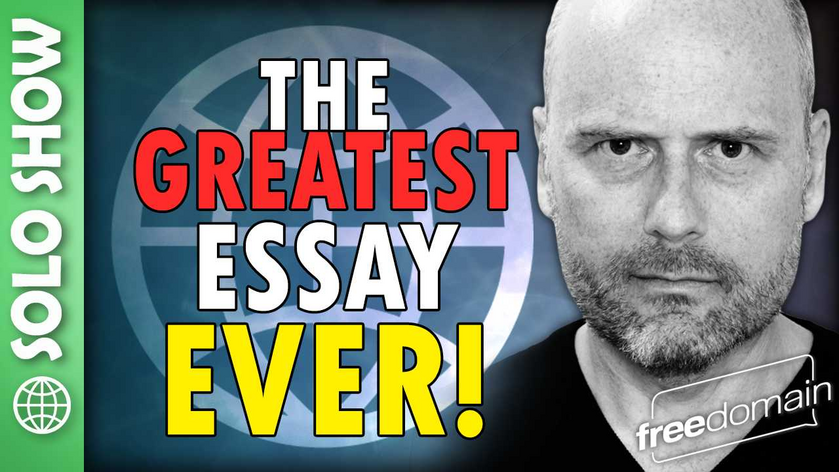
THE GREATEST ESSAY IN THE HISTORY OF PHILOSOPHY

Humanity evolves through accumulated wisdom from endless trial and error. This wisdom has been transmitted through fiction – stories, superstitions, commandments, and ancestor-worship – which has created the considerable problem that these fictions can be easily intercepted and replaced by other lies. 

Children absorb their moral and cultural wisdom from parents, priests and teachers. When governments take over education, foreign thoughts easily transmit themselves to the young, displacing parents and priests. In a fast-changing world, parents represent the past, and are easily displaced by propaganda. 

Government education thus facilitates cultural takeovers – a soft invasion that displaces existing thought-patterns and destroys all prior values. 

The strength of intergenerational cultural transmission of values only exists when authority is exercised by elders. When that authority transfers to the State, children adapt to the new leaders, scorning their parents in the process. 

This is an evolutionary adaptation that resulted from the constant brutal takeovers of human history and prehistory. If your tribe was conquered, you had to adapt to the values of your new masters or risk genetic death through murder or ostracism. 

When a new overlord – who represents the future – inflicts his values on the young, they scorn their parents and cleave to the new ruler in order to survive. 

Government instruction of the young is thus the portal through which alien ideas conquer the young as if a violent overthrow had occurred – which in fact it did, since government education is funded through force. 

This is the weakness of the cultural transmission of values – by using ‘authority’ instead of philosophy – reason and evidence – new authorities can easily displace the accumulated wisdom of thousands of years. 

It is a common observation that a culture’s success breeds its own destruction. Cultures that follow more objective reason tend to prosper – this prosperity breeds resentment and greed in the hearts of less-successful people and cultures, who then swarm into the wealthier lands and use the State to drain them dry of their resources. 

Everything that has been painfully learned and transmitted over a thousand generations can be scattered to the winds in a mere generation or two. 

This happens less in the realms of reason and mathematics, for obvious reasons. Two and two make four throughout all time, in all places, regardless of propaganda. The Pythagorean theorem is as true now as it was thousands of years ago – Aristotle’s three laws of logic remain absolute and incontrovertible to all but the most deranged. 

Science – absent the corrupting influence of government funding – remains true and absolute across time and space. Biological absolutes can only be opposed by those about to commit suicide. 

Authority based on lies hates the clarity and objectivity – and curiosity – of rational philosophy. Bowing to the authority of reason means abandoning the lies that prop up the powerful – but refusing to bow to reason means you end up bowing to foreigners who take over your society via the centralized indoctrination of the young. 

Why is this inevitable? 

Because it is an addiction. 

Political power is the most powerful – and dangerous – addiction. The drug addict only destroys his own life, and harms those close to him. The addiction to political power harms hundreds of millions of people – but the political junkies don’t care, they have dehumanized their fellow citizens – in order to rule over others, you must first view them as mere useful livestock instead of sovereign minds like your own. 

Just as drug addicts would rather destroy lives than stop using – political addicts would rather be slaves in their own sick system than free in a rational, moral world. 

If we cannot find a way to transmit morals without lies or assumptions, we will never break the self-destructive cycle of civilization – success breeds unequal wealth, which breeds resentment and greed, which breeds stealing from the successful through political power, which collapses the society. 

If we cannot anchor morals in reason and evidence, we can never build a successful civilization that does not engineer its own demise. Everything good that mankind builds will forever be dismantled using the same tools that were used to build it. 

Since the fall of religion in the West – inevitable given the wild successes of the free market and modern science and medicinewhich came out of skepticism, reason and the Enlightenment – we have applied critical reasoning to every sphere except morality. We have spun spaceships out of the solar system, plumbed the depths of the atom and cast our minds back to the very nanoseconds after our universe came into being – but we cannot yet clearly state why murder, rape, theft and assault are wrong. 

We can say that they are “wrong” because they feel bad, or are harmful to social cohesion, or because God commands it, or because they are against the law – but that does not help us understand what morality is, or how it is proven. 

Saying that rape is wrong because it feels bad to the victim does not answer why rape is wrong. Clearly it feels ‘good’ to the rapist – otherwise rape would not exist. 

Saying it harms social happiness or cohesion is a category error, since ‘society’ does not exist empirically. Individuals act in their own perceived self-interest. From an evolutionary perspective, ‘rape’ is common. The amoral genes of an ugly man that no woman wants are rewarded for rape, since it gives them at least some chance to survive. 

Saying that rape is wrong because God commands it does not answer the question – it is an appeal to an unreasoning authority that cannot be directly questioned. 

Saying that rape is wrong because it is illegal is begging the question. Many evil things throughout history have been legal, and many good things – such as free speech and absolute private property – are currently criminalized. 

Saying that rape is wrong because it makes the victim unhappy is not a moral argument – it is a strange argument from hedonism, in that the ‘morality’ of an action is measured only by pleasure and painWe often inflict significant misery on people in order to heal or educate them. We punish children – often harshly. The ‘hedonism’ argument is also used to justify sacrificing free speech on the altar of self-proclaimed ‘offense’ and ‘upset.’ 

So… 

Why is rape wrong? 

Why are murder, theft and assault immoral? 

A central tenet of modernity has been the confirmation of personal experience through universal laws that end up utterly blowing our minds. 

The theory of gravity affirms our immediate experience of weight and balance and throwing and catching – and also that we are standing on giant spinning ball rocketing around a star that is itself rocketing around a galaxy. We feel still; we are in fact in blinding motion. The sun and the moon appear to be the same size – they are in fact vastly different. It looks like the stars go round the Earth, but they don’t 

Science confirms our most immediate experiences, while blowing our minds about the universe as a whole. 

If you expand your local observations – “everything I drop falls” – to the universal – “everything in the universe falls” – you radically rewrite your entire world-view. 

If you take the speed of light as constant, your perception of time and space change forever – and you also unlock the power of the atom, for better and for worse. 

If you take the principles of selective breeding and animal husbandry and apply them to life for the last four billion years, you get the theory of evolution, and your world-view is forever changed – for the better, but the transition is dizzying. 

If we take our most common moral instincts – that rape, theft, assault and murder are wrong – and truly universalize them, our world-view also changes forever – better, more accuratemore moral – but also deeply disturbing, disorienting and dizzying. 

But we cannot universalize what we cannot prove – this would just be the attempt to turn personal preferences into universal rules: “I like blue, therefore blue is universally preferable.” 

No, we must first prove morality – only then can we universalize it. 

To prove morality, we must first accept that anything that is impossible cannot also be true. 

It cannot be true that a man can walk north and south at the same time. 

It cannot be true that a ball can fall up and down at the same time. 

It cannot be true that gases both expand and contract when heated. 

It cannot be true that water both boils and freezes at the same temperature. 

It cannot be true that 2 plus 2 equals both 4 and 5. 

If all men are mortal, and Socrates is a man, then it cannot be true that Socrates is immortal. 

If you say that impossible things can be true, then you are saying that you have a standard of truth that includes both truth and the opposite of truth, which is itself impossible. 

The impossible is the opposite of the possible – if you say that both the possible and the impossible can be true, then you are saying that your standard for truth has two opposite standards, which cannot be valid. This would be like saying that the proof of a scientific theory is conformity with reason and evidence, and also the opposite of conformity with reason and evidence, or that profit in a company equals both making money, and losing money. 

All morality is universally preferable behaviourin that it categorizes behaviour that should ideally be chosen or avoided by all people, at all timesWe do not say that rape is evil only on Wednesdays, or 1° north of the equator, or only by tall people. Rape is always and forever wrong – we understand this instinctively, though it is a challenge to prove it rationally. 

Remember, that which is impossible can never be true. 

If we put forward the proposition that “rape is universally preferable behaviour,” can that ever be true? 

If it is impossible, it can never be true. 

If we logically analyse the proposition that “rape is universally preferable behaviour,” we quickly find that it is impossible. 

The statement demands that everyone prefers rape – to rape and be raped at all times, and under all circumstances. 

Aside from the logistical challenges of both raping and being raped at the same time, the entire proposition immediately contradicts itself. Since it is self-contradictory, it is impossible, and if it is impossible, it can neither be true nor valid. 

If “rape is universally preferable behaviour,” then everyone must want to rape and be raped at all times. 

However, rape is by definition violently unwanted sexual behaviour. 

In other words, it is only “rape” because it is decidedly not preferred. 

Since the category “rape” only exists because one person wants it, while the other person – his or her victim – desperately does not want itrape cannot be universally preferable. 

No behaviour that only exists because one person wants it, and the other person does not, can ever be in the category of “universally preferable.” 

Therefore, it is impossible that rape is universally preferable behaviour. 

What about the opposite? Not raping? 

Can “not raping” logically ever be “universally preferable behaviour”? 

In other words, are there innate self-contradictions in the statement “not raping is universally preferable behaviour”? 

No. 

Everyone on the planet can simultaneously “not rape” without logical self-contradiction. Two neighbours can both be gardening at the same time – which is “not raping” – without self-contradiction. All of humanity can operate under the “don’t rape” rule without any logical contradictions whatsoever. 

Therefore, when we say that “rape is wrong,” we mean this in a dual sense – rape is morally wrong, and it is morally wrong because any attempt to make rape “moral” – i.e. universally preferable behaviour – creates immediate self-contradictions, and therefore is impossible, and therefore cannot be correct or valid. 

It is both morally and logically wrong. 

What about assault? 

Well, assault occurs when one person violently attacks another person who does not want the attack to occur. (This does not apply to sports such as boxing or wrestling where aggressive attacks are agreed to beforehand.) 

This follows the same asymmetry as rape. 

Assault can never be universally preferable behaviour, because if it were, everyone must want to assault and be assaulted at all times and under all circumstances. 

However, if you want to be assaulted, then it is not assault. 

Boom. 

What about theft? 

Well, theft is the unwanted transfer of property. 

To say that theft is universally preferable behaviour is to argue that everyone must want to steal and be stolen from at all times, and under all circumstances. 

However, if you want to be stolen from, it is not theft – the category completely disappears when it is universalized. 

If I want you to take my property, you are not stealing from me. 

If I put a couch by the side of the road with a sign saying “TAKE ME,” I cannot call you a thief for taking the couch. 

Theft cannot be universally preferable behaviour because again, it is asymmetrical, in that it is wanted by one party – the thief – but desperately not wanted by the other party – the person stolen from. 

If a category only exists because one person wants it, but the other person doesn’t, it cannot fall under the category of “universally preferable behaviour.” 

The same goes for murder. 

Murder is the unwanted killing of another. 

If someone wants to be killed, this would fall under the category of euthanasia, which is different from murder, which is decidedly unwanted. 

In this way, rape, theft, assault and murder can never be universally preferable behaviours. 

The nonaggression principle and a respect for property rights fully conform to rational morality, in that they can be universalized with perfect consistency. 

There is no contradiction in the proposal that everyone should respect persons and property at all times. To not initiate the use of force, and to not steal, are both perfectly logically consistent. 

Of course, morality exists because people want to do evil – we do not live in heaven, at least not yet. 

Universally preferable behaviour is a method of evaluating moral propositions which entirely accepts that some people want to do evil. 

The reason why it is so essential is because the greatest evils in the world are done not by violent or greedy individuals, but rather by false moral systems such as fascism, communism, socialism and so on. 

In the 20th century alone, governments murdered 250 million of their own citizens – outside of war, just slaughtering them in the streets, in gulags and concentration camps. 

Individual murderers can at worst kill only a few dozen people in their lifetime, and such serial killers are extraordinarily rare. 

Compare this to the toll of war. 

A thief may steal your car, but it takes a government to have you born into millions of dollars of intergenerational debt and unfunded liabilities. 

Now, remember when I told you that when we universalize your individual experience, we end up with great and dizzying truths? 

Get ready. 

What is theft? 

The unwanted transfer of property, usually through the threat of force. 

What is the national debt? 

The unwanted transfer of property, through the threat of force. 

Individuals in governments have run up incomprehensible debts to be paid by the next generations – the ultimate example of “taxation without representation.” 

The concept of “government” is a moral theory, just like “slavery” and “theocracy” and “honour killings.” 

The theory is that some individuals must initiate the use of force, while other individuals are banned from initiating the use of force. 

Those within the “government” are defined by their moral and legal rights to initiate the use of force, while those outside the “government” are defined by moral and legal bans on initiating the use of force. 

This is an entirely contradictory moral theory. 

If initiating the use of force is wrong, then it is wrong for everyone, since morality is universally preferable behaviour. 

If all men are mortal, we cannot say that Socrates is both a man and immortal. 

If initiating force is universally wrong, we cannot say that it is wrong for some people, but right for others. 

“Government” is a moral theory that is entirely self-contradictory – and that which is self-contradictory is impossible – as we accepted earlier – and thus cannot be valid. 

If a biologist creates a category called “mammal” which is defined by being warm-blooded,” is it valid to include cold-blooded creatures in that category? 

Of course not. 

If a physicist proposes a rule that all matter has the property of gravity, can he also say that obsidian has the property of antigravity? 

Of course not. 

If all matter has gravity, and obsidian is composed of matter, then obsidian must have gravity. 

If we say that morality applies to all humanscan we create a separate category of humans for which the opposite of morality applies? 

Of course not. 

I mean, we can do whatever we want, but it’s neither true nor moral. 

If we look at something like counterfeiting, we understand that counterfeiting is the creation of pretend currency based on no underlying value or limitation. 

Counterfeiting is illegal for private citizens, but legal – and indeed encouraged – for those protected by the government. 

Thus, by the moral theory of “government,” that which is evil for one person, is virtuous for another. 

No. 

False. 

That which is self-contradictory cannot stand. 

People who live by ignoring obvious self-contradictions are generally called insane. 

They cannot succeed for long in this life. 

Societies that live by ignoring obvious self-contradictions are also insane, although we generally call them degenerate, decadent, declining and corrupt. 

Such societies cannot succeed for long in this world. 

The only real power – the essence of political power – is to create opposite moral categories for power-mongers. 

What is evil for you is good for them. 

It is disorienting to take our personal morals and truly universalize them. 

So what? 

Do you think we have reached the perfect end of our moral journey as a species? 

Is there nothing left to improve upon when it comes to virtue? 

Every evil person creates opposite standards for themselves – the thief says that he can steal, but others should not, because he doesn’t like to be stolen from! 

Politicians say that they must use violence, but citizens must not. 

Nothing that is self-contradictory can last for long. 

You think we have finished our moral journey? 

Of course not. 

Shake off your stupor, wake up to the corruption all around and within you. 

Like “government,” slavery was a universal morally-justified ethic for almost all of human history. 

Until it wasn’t. 

Read full Article
Essay Feedback Requested!

Good evening, my wonderful donors! I'd appreciate if you could take the time to read this essay and give me your feedback!

Thanks so much!!

Only for Supporters
To read the rest of this article and access other paid content, you must be a supporter
Read full Article
See More
Available on mobile and TV devices
google store google store app store app store
google store google store app tv store app tv store amazon store amazon store roku store roku store
Powered by Locals